

Incentive compensation management streamlines how businesses design, calculate, and distribute variable pay, ensuring sales teams are rewarded accurately and on time while reducing manual errors.
- Eliminate chaos and disputes caused by manual commission tracking and spreadsheets.
- Automate calculations, align payouts with business strategy, and boost transparency for all stakeholders.
- Free up finance and operations teams to focus on strategic work, not admin.
- Build trust and motivation with real-time performance visibility.
Incentive compensation management controls how companies design, calculate, approve, and pay variable compensation. It gives sales reps and go-to-market teams a clear path from performance to payout, without finance and RevOps rebuilding commission logic in spreadsheets every cycle.
Revenue operations and finance leaders at fast-growing SaaS companies use ICM to replace fragmented spreadsheets with a centralized, automated system that scales alongside the team.
A modern ICM system brings the core compensation workflow into one place. That includes:
- Designing commission plans and bonus plans aligned with business strategy
- Assigning quotas and territories
- Crediting sales accurately across teams and roles
- Calculating commissions in real time
- Processing payouts and managing approvals
- Resolving disputes quickly and transparently
- Reporting performance to sales, finance, and leadership
When compensation is managed well, it shifts from a backend administrative burden to something that actively shapes how reps sell and how the business grows. The Bridge Group's 2024 SaaS AE Metrics Report found that only 51% of account executives hit quota in 2024, down from 66% in 2022, reinforcing how difficult quota attainment has become for modern sales teams.
Clearly, misaligned incentive structures are one of the leading structural causes. ICM gives organizations a way to close that gap.
Is this guide for you?
- You lead RevOps, Finance, or Sales at a fast-growing SaaS, AI, or technology company
- Your company has 20+ commissionable payees
- Industries: SaaS, medical devices, manufacturing, IT services, and HealthTech
- Goal: Scale incentive programs, reduce payout errors, and improve revenue performance
Types of Incentive Compensation
Commissions and bonuses form the foundation of most variable pay programs, while SPIFs and equity add flexibility for specific priorities. Each type serves a distinct purpose and works best in specific contexts. Below is a breakdown of the most common types of incentive compensation used across industries.
Overview of six common incentive compensation types with definitions, ideal use cases, and examples.
High-performing sales organizations combine several of these incentive types. Commissions and bonuses form the foundation, while SPIFs add flexibility to address short-term priorities. The right mix depends on your sales motion and team structure.
How Incentive Compensation Management Works
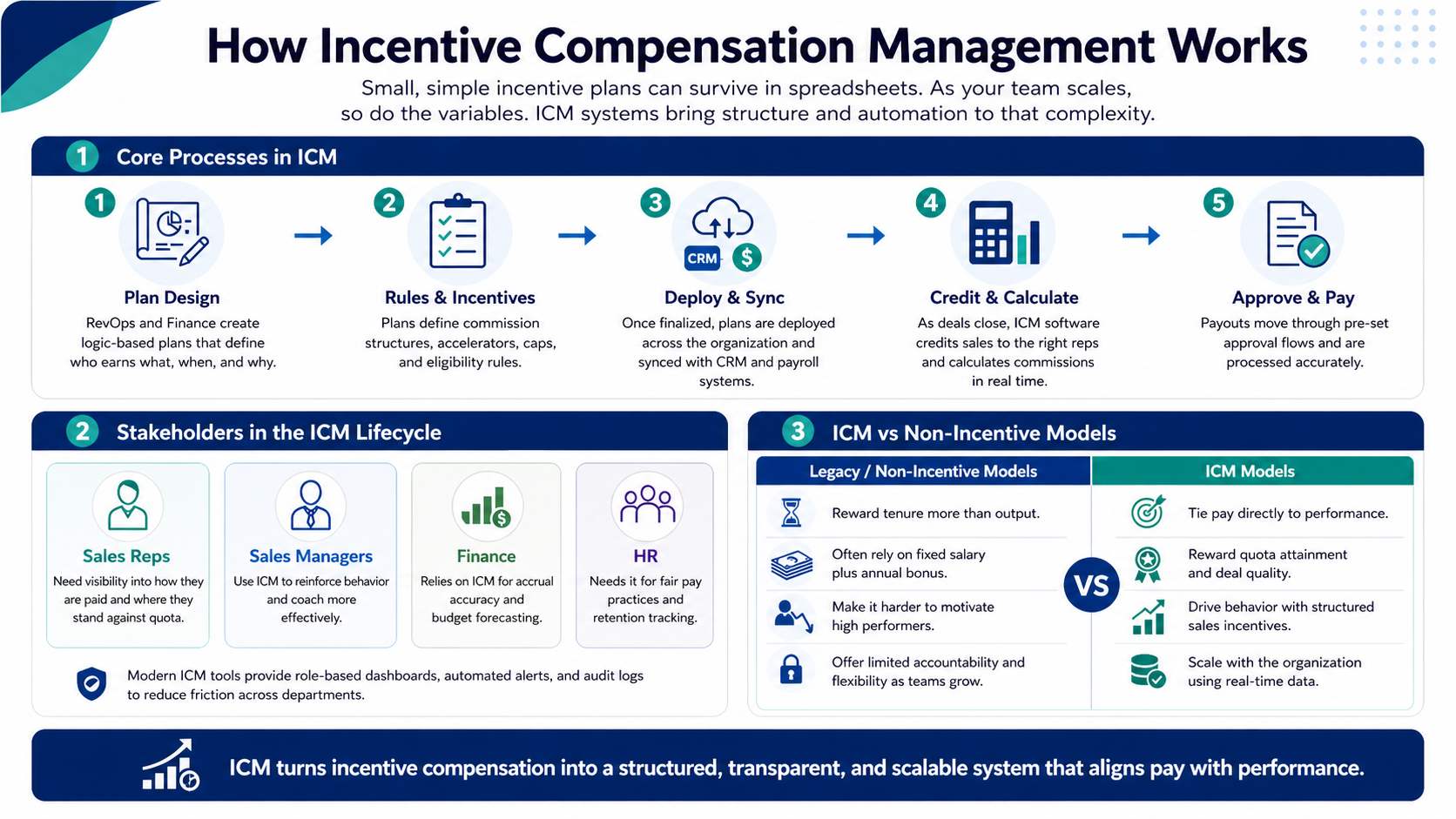
Small, simple incentive plans can survive in spreadsheets. As your team scales, so do the variables. ICM systems bring structure and automation to that complexity.
Here is how ICM works across its core processes and stakeholders:
Core Processes in ICM
ICM starts with plan design. RevOps and finance define how each role earns commission, which deals qualify, when accelerators apply, where caps begin, and which exceptions need approval. The plan becomes the source of truth for crediting, calculation, payout timing, and audit review.
Once the plan is approved, the system connects it to CRM, payroll, and finance workflows. Closed-won deals flow into the commission engine, where the software applies the right crediting rules, calculates expected earnings, and flags exceptions before payout.
Approvals then move through a controlled workflow. Finance can review the payout logic, managers can resolve disputes with a clear audit trail, and reps can see how their commission was calculated before the cycle closes.
Stakeholders in the ICM Lifecycle
Incentive compensation is a shared system of record for Sales, Finance, and HR leadership.
- Sales reps need visibility into how they're paid.
- Operations owns the plan design, system configuration, and ongoing accuracy of the ICM process.
- Sales managers use it to reinforce behavior and coach effectively.
- Finance relies on it for accrual accuracy and budget forecasting.
- HR needs it for fair pay practices and retention tracking.
Each stakeholder touches a different part of the ICM workflow. Modern ICM tools address this with role-based dashboards and automated alerts. Audit logs keep everyone aligned and reduce friction across departments.
ICM vs Non-Incentive Models
Legacy comp models reward tenure, with no direct link between output and earnings. A rep might receive a fixed base salary and an annual bonus simply for staying. That structure makes it difficult to motivate high performers or reward initiative.
ICM ties pay to performance through structured sales incentives. Reps earn based on quota attainment and deal quality instead of tenure-based increments. The structure drives behavior, supports accountability, and scales as your org grows, especially when backed by real-time data.
Incentive Compensation Management vs. Sales Performance Management
ICM automates the financial side of compensation, while SPM addresses the behavioral side of sales execution. Both improve how sales teams operate, but they serve distinct purposes.
Are ICM and SPM the Same?
ICM and SPM are related, but they solve different problems.
Incentive Compensation Management focuses on the money side of sales performance. It calculates who gets paid, how much they earn, which rule applies, and when the payout moves to approval. If a rep questions a commission, ICM should show the deal, plan rule, crediting logic, and payout history behind the number.
Sales Performance Management covers a wider set of sales-execution workflows. It helps leaders plan territories, assign quotas, coach reps, track progress, and understand where performance is improving or slipping.
ICM usually becomes urgent when payout errors, disputes, or spreadsheet-based commission cycles slow finance down. SPM becomes urgent when sales leaders need better control over rep performance, territory coverage, and quota attainment.
Key Differences Between ICM and SPM
The biggest distinction lies in intent and outcomes. ICM makes sure pay is right. SPM helps ensure performance is right. Here is a quick comparison:
Side-by-side comparison of ICM and SPM across primary goal, users, focus areas, and tech capabilities.
When to Use ICM vs. SPM
Compensation confusion, rep disputes, and payout delays signal the need for ICM first. If reps are paid correctly but still missing quota, bring in SPM to improve sales execution.
Use ICM when you need to:
- Scale commission payouts without manual work
- Improve trust in compensation plans
- Give reps real-time earnings visibility
Use SPM when you need to:
- Reduce ramp time for new reps
- Identify top and bottom performers
- Improve coaching and goal-setting
A modern ICM system is only as strong as the components it is built on. Each part plays a critical role in ensuring payouts are timely and aligned with business goals.
Why Incentive Compensation Management Matters
Why Incentive Compensation Management Matters
Accurate payouts, strategic alignment, and rep trust all depend on how well you manage incentive compensation. When managed well, it aligns teams to strategic goals and supports compensation strategies that reduce costly inefficiencies.
Aligning Sales Behavior with Strategy
A well-structured plan shapes how reps sell and ensures alignment with your broader sales strategy. According to McKinsey, companies that focus on performance alignment are 4.2 times more likely to outperform peers, driving 30% higher revenue growth and reducing attrition by five points. ICM systems make this possible by letting teams model and adjust plans in real time to match shifting business priorities.
Driving Accountability and Motivation
Reps stay engaged when they clearly understand how their performance translates to earnings. A Gallup report found that employees who strongly agree they get the right amount of recognition are 4x as likely to be engaged. Employees receiving authentic recognition are 5.2x as likely to envision a growth path.
With real-time dashboards and clear visibility into how goals link to incentives, reps sell with confidence. Leadership fosters a culture of trust and accountability.
Reducing Manual Errors and Disputes
Spreadsheet-based commission tracking breaks down when plans include accelerators, split credits, clawbacks, exceptions, and mid-cycle changes. A small formula error can delay payouts, trigger disputes, and pull RevOps and finance into days of manual checking.
70% of sellers feel overwhelmed by the number of technologies required to do their work. When commission tracking adds friction instead of removing it, disengagement follows.
ICM tools calculate commissions from approved deal data, apply validation checks, and create a record for every payout. Built-in audit trails show which rule applied, who approved the change, and where the number came from.
Role-based access also keeps the workflow controlled. Reps can review their earnings, managers can resolve questions, and finance can approve payouts without chasing screenshots, spreadsheet versions, or side-channel explanations.
Key Components of an Incentive Compensation Management System
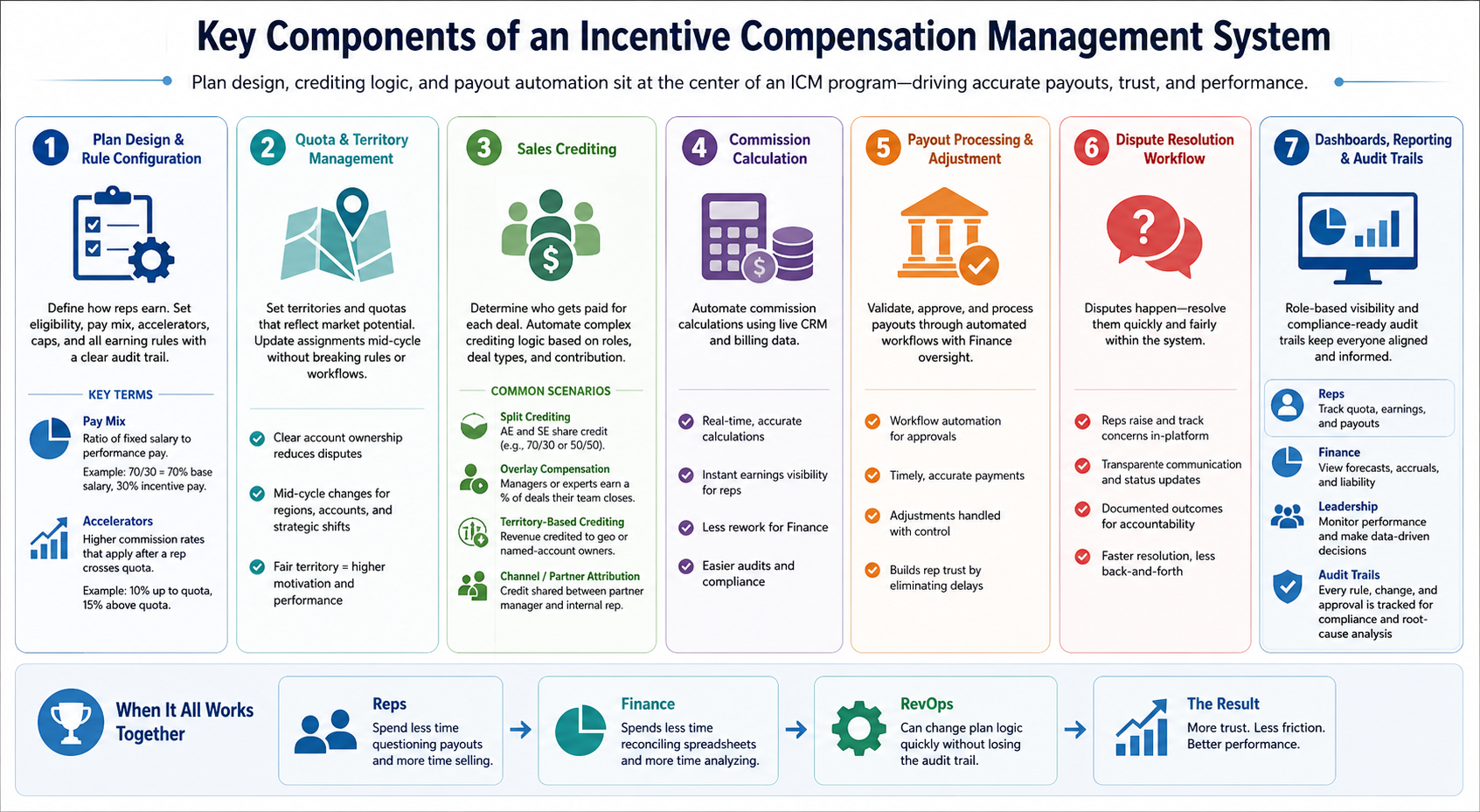
Plan design, crediting logic, and payout automation sit at the center of an ICM program. Plan design defines how reps earn. Crediting logic decides which rep, team, or role gets paid for each deal. Payout automation applies the rules, routes exceptions for approval, and moves approved commission data to payroll.
When these three pieces work from the same system, reps spend less time questioning payouts, finance spends less time reconciling spreadsheets, and RevOps can change plan logic without losing the audit trail.
1. Plan Design and Rule Configuration
Every ICM program starts with the earning rules. RevOps and finance define who is eligible for commission, how much of each role’s compensation comes from variable pay, when accelerators apply, and where caps begin.
The best ICM systems let teams configure these rules without rebuilding the plan from scratch every time targets change. Finance can update payout logic, RevOps can manage exceptions, and reps can see what they need to do to earn. Clean plan design also matters during audits because every rule, change, and approval needs a clear record.
Key terms:
- Pay mix refers to the ratio of fixed salary to performance-based pay. For example, a 70/30 mix means 70% base salary and 30% incentive pay.
- Accelerators are higher commission rates that apply after a rep crosses quota. A rep might earn 10% up to quota and 15% on revenue above quota.
2. Quota and Territory Management
Territories and quotas shape earning potential before the first deal closes. If account ownership is unclear or quota targets no longer match market potential, commission disputes follow later.
Growing teams often need mid-cycle changes when regions shift, new accounts open, or strategic segments get reprioritized. A strong ICM tool lets RevOps update territory and quota assignments without breaking crediting rules, payout calculations, or approval workflows, all through a robust planning layer.
Fair territory assignment matters because reps need to trust the plan they are selling against. When two reps believe they own the same account, or one territory carries far more opportunity than another, motivation drops before performance does.
3. Sales Crediting
Crediting determines who gets paid for a deal, frequently involving multiple contributors. Modern ICM platforms handle complex crediting logic automatically, factoring in roles and deal types. Automated crediting reduces disputes and improves transparency across the organization.
Common crediting scenarios include:
- Split Crediting: Multiple reps (e.g., AE and SE) share credit for a deal, such as a 70/30 or 50/50 revenue split, based on contribution
- Overlay Compensation: Senior reps or managers (like regional VPs or solution consultants) earn a percentage of deals closed by the reps they support
- Territory-Based Crediting: Revenue is credited based on geographic or named-account ownership, even if another rep helped influence the deal
- Channel or Partner Attribution: Deals sourced or closed with partners are credited partially to the partner manager and the internal sales rep
4. Commission Calculation
Manually tracking sales commission payments drains time and introduces risk. ICM tools automate calculations using live CRM and billing data. Reps get instant earnings visibility, Finance avoids rework, and leadership gets accurate reporting. Automated systems are also easier to audit.
5. Payout Processing and Adjustment
After commissions are calculated, payouts need validation and approvals. ICM platforms streamline this through workflow automation, ensuring timely, accurate payments while preserving Finance oversight. Eliminating delays builds rep trust.
6. Dispute Resolution Workflow
Disputes arise, but they do not have to cause chaos. Built-in resolution tools let reps raise concerns and track outcomes in-platform, reducing back-and-forth and ensuring transparency. Everything is documented, helping teams resolve issues quickly and fairly.
7. Dashboards, Reporting & Audit Trails
Role-based visibility and compliance-ready audit trails keep every stakeholder aligned. Reps track quota progress, Finance sees forecasts, and leaders get performance insights. Detailed audit trails also support root-cause analysis if errors arise.
Aligning Incentive Compensation with Business Strategy and Systems
Incentive plans frequently fall short because they are built in isolation, disconnected from business goals and cross-functional input. Here is how to connect incentives with strategy and systems that scale.
Align Incentives to Business Objectives
Incentives work best when they are directly tied to outcomes that matter, such as net new revenue or churn reduction.McKinsey found that companies aligning financial incentives with transformation outcomes achieved nearly five times the total shareholder returns compared to those that did not. These programs also helped increase employee accountability and engagement across teams.
With a modern ICM system, incentive plans can be adapted in real time to match shifting business goals. Leadership can steer execution without overhauling the entire structure.
Cross-Functional Collaboration with Finance, HR, and Sales Ops
Compensation planning is a cross-functional effort requiring Finance visibility for budgeting, HR oversight for fairness, and Sales Ops execution for operational accuracy.
ICM platforms provide a shared source of truth that lets these teams coordinate territory planning and headcount forecasts without relying on siloed tools or inconsistent data. Collaboration ensures that plans are executable, sustainable, and aligned across the board.
Strategic System Integration Across CRM, ERP, and HR Platforms
Data silos create inconsistencies, delays, and errors in crediting and payouts, even when plan design is strong. A connected ICM platform integrates with systems like Salesforce, NetSuite, and Workday, pulling in real-time performance data and pushing out accurate earnings info to payroll and reporting tools.
Integration reduces duplicate work, ensures accurate payouts, and provides full visibility across teams. That visibility is crucial for scalability and trust.
Challenges in Managing Incentive Compensation
Plan overengineering and data integration gaps are two of the most common obstacles companies face at scale. Below are the challenges that compound as incentive programs grow.
1. Plan Complexity and Overengineering
As teams try to make plans "fair" or performance-specific, they layer on too many rules and exceptions. What starts as a well-intentioned plan can quickly become confusing and demotivating for sales reps who struggle to understand how they are being paid. Common issues include:
- Too many commission tiers (e.g., 10%, 12%, 13.5%, 15%...)
- Territory overlaps that create internal friction and credit disputes
- Exception-heavy rules for every product or region, leading to inconsistent compensation and administrative overload
2. Data Integration and Accuracy
Accurate payouts depend on clean, consistent data, which becomes harder to maintain as multiple systems feed into your ICM process. CRM, ERP, and HR tools carry overlapping but mismatched information, leading to missed credits and payout delays.
3. Delayed Payouts and Low Trust
When commissions are paid late or inaccurately, rep confidence in the system erodes. Delays usually stem from manual processes and disjointed approvals, turning what should be a motivation boost into a source of friction.
4. Limited Visibility for Reps
When reps cannot see how they are tracking against targets, disengagement follows. Without visibility, it is difficult for them to course-correct or prioritize efforts, and that gap leads to missed goals.
ICM tools solve this by offering real-time dashboards and performance tracking. Many teams still operate in spreadsheets or clunky legacy systems that keep reps in the dark. The less visibility reps have, the less motivated they feel.
Risks of Poorly Designed Incentive Compensation Plans
Misaligned selling behavior and increased turnover represent deeper strategic risks that undermine revenue performance and organizational health. Understanding these risks helps leadership prioritize getting compensation right from the start.
- Misaligned selling behavior: When incentives reward volume over deal quality, reps optimize for short-term wins that erode long-term business goals. High churn rates and discounting abuse follow.
- Increased sales turnover: Reps who feel underpaid or confused by their plan are more likely to leave. Replacing a sales rep costs an estimated 1.5 to 2 times their annual on-target earnings when factoring in recruiting and ramp time.
- Compliance and legal exposure: Inconsistent or undocumented compensation practices create audit risks and potential legal liability, particularly for organizations operating across multiple jurisdictions with varying labor regulations.
- Financial inaccuracy: Overpayments, underpayments, and untracked clawbacks directly impact the bottom line. Without automated validation, these errors compound over time and erode trust between Finance and Sales.
- Demotivation and disengagement: Plans that are too complex or perceived as unfair lead to widespread disengagement. Reps stop trusting the system and shift focus away from high-value activities.
The cost of getting incentive compensation wrong extends far beyond a single missed payout. It affects retention and revenue predictability. A modern ICM platform mitigates these risks by enforcing consistency, transparency, and data-driven plan design.
How to Design an Incentive Compensation Management Plan
Defining measurable outcomes and choosing a balanced pay mix are the two most important starting points for any incentive plan. While every organization's comp structure is unique, strong plans follow foundational principles focusing on balanced strategy and simplicity.
- Define outcomes first: Focus on measurable goals to support business strategy, like new ARR or deal size.
- Choose a balanced pay mix: Align base vs. variable pay to your sales motion and risk appetite.
- Set clear, achievable quotas: Use performance data and pipeline trends to avoid over- or under-targeting.
- Keep rules simple: Avoid too many tiers or exceptions that confuse reps or slow down Finance.
- Test before rollout: Simulate payouts using past deals to spot logic gaps or unfair scenarios.
Organizational and Behavioral Principles Behind Plan Design
Behavioral alignment and transparent communication are the two principles which separate effective plans from confusing ones.
- Behavioral alignment: Incentive plans should reflect how reps make decisions. Clear, immediate rewards are easier to act on than delayed incentives buried behind complex rules.
- Communication and transparency: A plan that reps do not understand will fail to motivate. Invest in clear documentation and accessible dashboards so every rep knows exactly how their actions translate to earnings.
- Ongoing review and iteration: Treat plan design as a living process. Gather feedback from reps and managers each quarter, analyze payout distributions, and adjust for fairness and effectiveness.
- Cross-functional input: Involve Finance, HR, and Sales leadership in the design process from the start. Plans designed in a silo miss critical constraints around budget and compliance.
Best Practices for Optimizing Incentive Compensation Management
Strong compensation plans do two things well: they point reps toward the right business outcomes, and they stay simple enough to manage as the team grows.
The plan should make priorities obvious. If the business needs more expansion revenue, better deal quality, or stronger pipeline in a strategic segment, the incentive structure should reward those actions directly. Use these five practices to refine your compensation plan:
1. Align Incentives to Business Objectives
If your compensation plan does not support your company's most important goals, it is actively working against you. Incentives should guide reps toward actions to drive impact, whether that is increasing ACV or boosting customer retention.
Start by asking: What outcomes matter most this quarter? Then check whether your current incentive model rewards those outcomes. If it does not, update the structure. Reps chase what you pay them for, so make sure it is worth chasing.
2. Simplify Plans for Scalability
Designing a "perfect" plan accounts for every role and exception is tempting. As you scale, complexity becomes your enemy. Reps will not trust what they cannot understand, and Finance will not either.
Simplifying does not mean lowering standards. It means making the path to earnings crystal clear. Fewer tiers and plain-language rules ensure everyone, from new hires to senior reps, knows exactly how to win.
3. Empower Reps with Real-Time Dashboards
A motivated rep is an informed rep. When sellers can see how close they are to hitting quota or triggering an accelerator, they stay focused and push for the extra deal.
Dashboards are engagement tools, not optional extras. Reps should never have to email RevOps to figure out what they have earned. A real-time view into performance and payout timelines builds trust and reduces noise across teams.
4. Automate Where Possible
Manual processes increase risk alongside slowing things down. Every time someone updates a spreadsheet, there is a chance for error or a missed commission.
Automating key workflows like crediting and payout processing helps you scale with confidence. It also frees up time for RevOps and Finance to focus on strategy instead of chasing down data fixes.
5. Review and Optimize Plans Regularly
A static comp plan becomes outdated the moment your market shifts or your team grows. Ongoing reviews are essential to keep plans relevant.
Set a quarterly or biannual rhythm for reviewing performance data and rep feedback. Use this insight to test small adjustments, like tweaking accelerators or removing friction points, so your plan keeps driving the behavior you want.
Benefits of Implementing a Modern ICM Solution
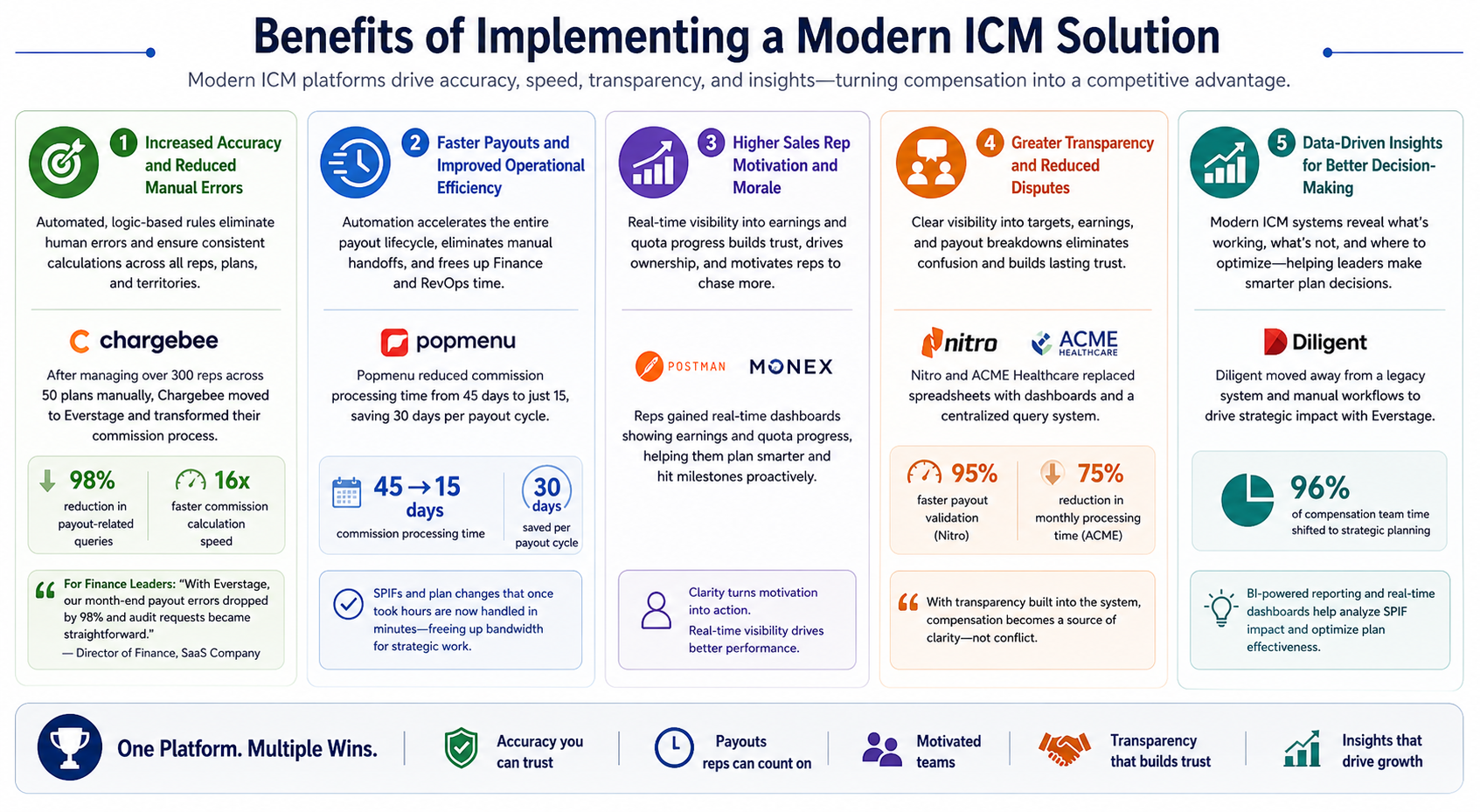
Accuracy gains and faster payouts are the two most immediate benefits companies experience when they shift from manual to automated incentive compensation management. Below are the core advantages in detail.
Increased Accuracy and Reduced Manual Errors
Manual commission tracking is a source of constant risk. As compensation plans grow in complexity, so do the chances of miscalculations and overpayments. A modern ICM platform eliminates these errors by applying logic-based rules consistently across all reps and territories.
Chargebee's experience with Everstage proves this at scale. After managing over 300 reps across 50 plans manually, the team moved to a fully automated system that slashed commission errors and boosted payout confidence. The result: a 98% reduction in payout-related queries and a 16x faster commission calculation speed. What was once spreadsheet chaos became a streamlined, trustworthy compensation engine.
Faster Payouts and Improved Operational Efficiency
Delayed commissions frustrate reps, slow down Finance, and damage morale. A modern ICM platform speeds up the entire payout lifecycle by automating calculations and removing manual handoffs between teams.
Popmenu achieved exactly this with Everstage. Their team reduced commission processing time from 45 days to just 15, saving 30 days per payout cycle.
As a result, SPIFs and plan changes that once required hours of coordination are handled in minutes. Automating the admin workload freed up bandwidth to focus on strategic execution.
Higher Sales Rep Motivation and Morale
Reps perform better when they know exactly how they are being paid and can see their earnings in real time. When commissions are hidden behind laggy systems or surprise payouts, disengagement and low morale follow. ICM platforms restore trust by giving reps clear, on-demand visibility into what they have earned and what they can earn.
In Everstage deployments at Postman and Monex, sales reps gained real-time access to dashboards showing earnings and quota progress. With greater clarity, reps planned smarter and chased milestones proactively. Motivation became measurable, not anecdotal.
Greater Transparency and Reduced Disputes
Commission disputes almost always trace back to one issue: lack of clarity. When reps cannot see how their payouts are calculated, trust breaks down fast. A modern ICM platform puts everything in plain view: targets, earnings, and payout breakdowns.
Companies like Nitro and ACME Healthcare used Everstage to replace spreadsheets with always-on dashboards and a centralized query system. Nitro saw 95% faster payout validation, while ACME cut monthly processing time by 75% and restored trust across their sales floor. With transparency built into the system, compensation became a source of clarity.
Data-Driven Insights for Better Decision-Making
ICM should guide strategy and manage payouts. Modern ICM systems show which plans drive the right behavior, where payout costs are rising, and which incentives need adjustment. When compensation data stays buried in spreadsheets or split across systems, leaders lose the visibility needed to make timely plan decisions.
Diligent turned this around with Everstage. After moving away from a legacy system and manual workflows, they shifted 96% of their compensation team's time to strategic planning. With BI-powered reporting and real-time dashboards, they analyze SPIF impact and optimize plan effectiveness. What used to be an operational burden is now a growth lever.
How to Choose the Right Incentive Compensation Management Software
Evaluating integration depth and scalability are the two most important factors when selecting ICM software. The right platform reduces admin overhead, ensures timely payouts, and lets your comp plan adapt as your business scales. Here is how to evaluate what fits best for your team.
Key Features to Look For
While every team has unique needs, here is how to prioritize must-have features based on your company's size and scale:
Essential for All Teams
- Rule-based commission engines
Automate comp logic without relying on engineering. Tools like Everstage offer no-code rule builders for RevOps and Finance. - Real-time visibility for reps and managers
Reps should see their earnings and next targets at a glance, without pinging Finance every week.
Important for Scaling Companies
- Plan modeling and simulation
Test "what-if" scenarios, like changing accelerators or quota cycles, before rollout. - Audit trails and version history
Maintain logs of plan edits and payout adjustments for compliance and dispute resolution.
Advanced for Enterprise Teams
- Multi-currency and localization support
Manage global teams with support for different currencies, tax rules, and payout timelines. - Integrations with HRIS, CRM, and payroll systems
Ensure seamless data flow across platforms like Salesforce, Workday, and NetSuite.
Integration with CRM and ERP
Your ICM software is only as good as the data it connects to. If you are still importing spreadsheets or syncing manually, you are setting yourself up for payout errors and shadow accounting.
- CRM integration (e.g., Salesforce, HubSpot)
Deal data lives here. Syncing deal stages, closed dates, and ACVs ensures that your commission logic triggers correctly and on time. - ERP and HRIS connectivity (e.g., NetSuite, Workday)
Compensation relies on finance and HR inputs: employee status, territory changes, and fiscal periods. Native or API-based connections here are critical.
Tools like Everstage support seamless integration with both CRM and ERP systems, reducing manual effort and ensuring your data stays in sync. - Two-way sync capabilities
Your ICM platform should also push updates back to your systems of record (like payroll or ERP). Final earnings, clawbacks, and adjustments must be accurately reflected downstream. Why it matters:- Prevents data silos by keeping all systems aligned in real time
- Ensures payroll accuracy and eliminates manual data entry errors
- Maintains audit trails by logging what was pushed, when, and by whom
Without two-way sync, your team risks duplicate work, misaligned payouts, and compliance gaps.
Vendor Evaluation Checklist
Before committing, use this checklist to make sure your vendor meets both functional and strategic needs. For complex plan structures, ask if the vendor offers a proof of concept, a good ICM partner should be able to build out your most complicated plan before you sign.
- Can the software scale with our sales team over the next 2–3 years?
- Does it support our current and future compensation structures (SPIFs, overlays, draw plans)?
- Is there support for global teams, including currencies and compliance?
- What kind of onboarding and customer success support is included?
- How frequently does the product release updates or improvements?
- Are audit logs, compliance certifications, and data security measures in place?
- Can non-technical users update rules and logic without engineering help?
- What do integrations with Salesforce and NetSuite actually look like: native or custom-built?
- Does the platform provide intuitive reporting dashboards for both admins and payees?
Revamp Incentive Compensation Management with Everstage
Incentive compensation management is about performance, trust, and growth. When reps trust the system and Finance trusts the data, everyone moves faster and more confidently. A modern ICM platform provides the same foundation. It turns compensation from an administrative burden into a strategic advantage.
If your current system falls short, it is holding your team back. Start by auditing what is working, where friction exists, and how better systems could close the gap. Then make the case internally: your sales team deserves better. So does your bottom line.
If you are evaluating platforms that bring clarity and real-time visibility to the entire compensation lifecycle, book a quick demo with Everstage and see how it fits your team's workflow.

.avif)
.avif)


.avif)

.avif)

.avif)